Before you read the findings
Guess the result
How did the AI-designed burgers do in the blind taste test?
What did AI actually solve?
A generative model produced two burger recipes that held their own in a small blind restaurant tasting, making this a credible proof of concept for AI-assisted food development. The result is more concrete than a recipe benchmark because people ate the output. It still depends on chefs, a narrow group of tasters, modeled nutrition and environmental scores, and an original Big Mac that was not prepared under the generated burgers' study protocols. AI found promising ingredient combinations; it did not replace the test kitchen or solve the trade-off between taste, health, and sustainability.
What changed
Recipe generators usually produce instructions one word at a time. This Stanford team took a more structured route: it trained a diffusion model on the ingredients and quantities in 2,216 human-authored burger recipes. The model learned which of 146 ingredients tend to appear together and in what amounts, then generated one million candidate recipes. Researchers filtered that pool for familiar combinations, novelty, estimated environmental impact, or nutritional scores.
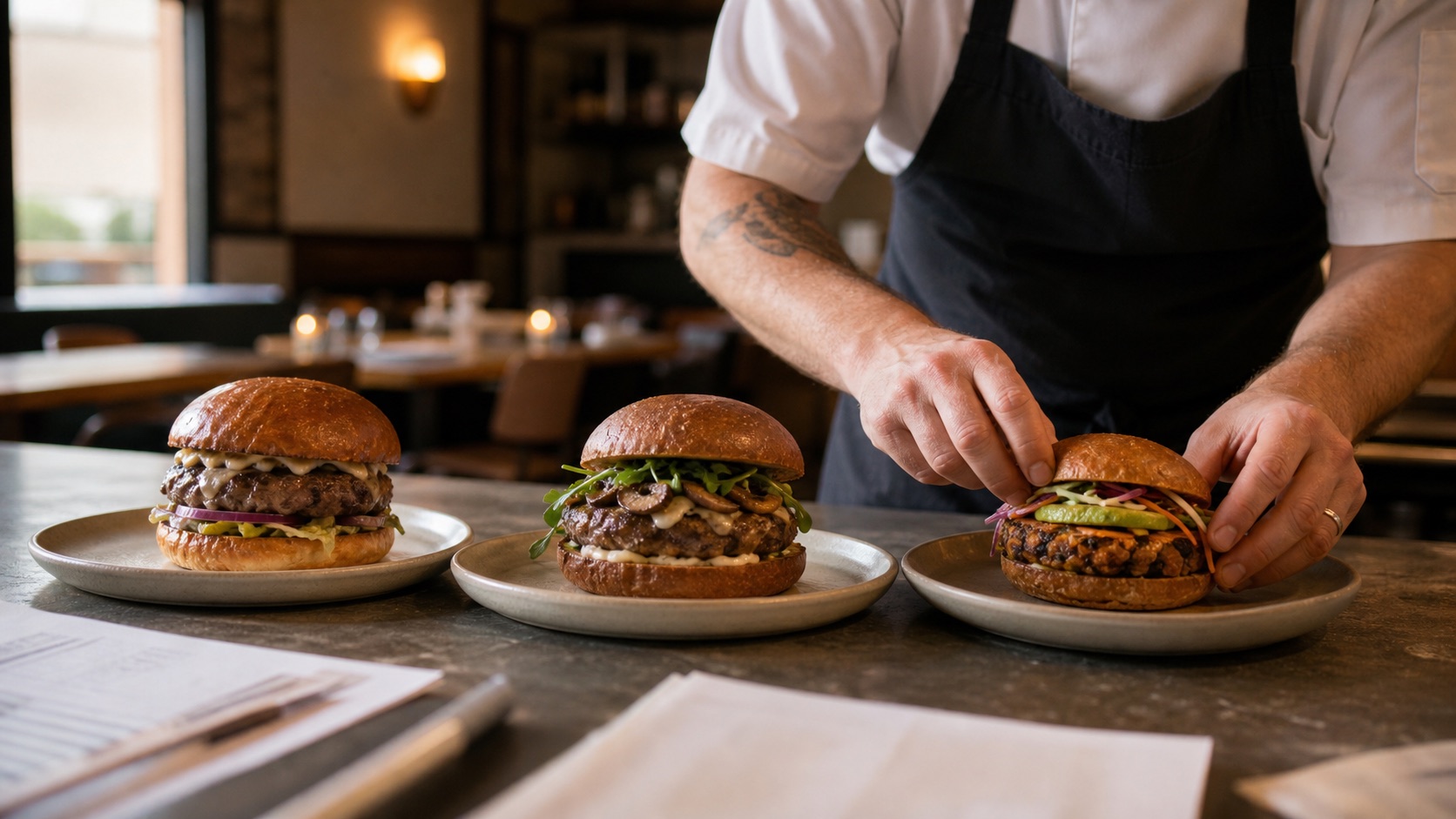
The real test happened at a San Francisco restaurant. An executive chef first turned the model's ingredient lists into standardized cooking and assembly instructions, and an independent group of chefs prepared five generated burgers. In a blind tasting, 101 adult volunteers rated every generated burger and an original Big Mac obtained by the independent preparation team on seven-point scales for overall liking, flavor, and texture. Separately, the researchers synthesized four online copycat recipes into a reference ingredient list used to test whether the model could rediscover a Big Mac-like formulation; that reconstructed recipe was not the tasting control. 01 / Source noteGenerative artificial intelligence creates delicious, sustainable, and nutritious burgersnpj Science of Food · 2026What the source supportsBlinded restaurant tasting · 101 adultsKeep in mindThe tasting was one convenience sample of 101 volunteers at one San Francisco restaurant. Sixty-five percent identified as omnivores and 35% as flexitarians; the paper reports no vegetarians or vegans in the sample. The study did not randomly recruit a nationally representative group, test repeat purchases, measure what people would pay, or compare the model with professional food developers working under the same brief. It also did not report an advance power calculation and did not adjust its planned statistical tests for multiple comparisons.Read the original source ↗
Two recipes selected for deliciousness matched or beat that comparison on the measured attributes. The more novel of the two averaged 5.7 for overall liking versus 5.3 for the comparison, and 5.8 versus 5.4 for flavor; both differences were statistically significant. Its texture rating did not differ significantly. The other delicious burger also rated higher for flavor, 5.8 versus 5.4, while its overall-liking and texture scores were not significantly different.
The optimization trade-offs were visible, too. A beef-and-mushroom burger rated about the same as the comparison on all three sensory measures, but its modeled environmental-impact score was also about the same. A mushroom-only burger had a modeled impact score of 0.06 versus 0.93 for the comparison—more than an order of magnitude lower—but tasters liked its flavor, texture, and overall experience less. A bean burger scored 63.12 on the study's Healthy Eating Index calculation versus 33.71 for the comparison, yet it also received the lowest taste ratings.
What this could change for you
For shoppers, the near-term change is likely to happen behind the menu or package. Food developers can use a model like this to search far more ingredient combinations than a test kitchen could cook, then hand a shortlist to chefs and tasters. That could make it cheaper to explore products that balance taste with nutrition, environmental impact, price, allergens, or whatever other constraint a developer can measure reliably.
The study also offers an honest picture of what optimization can and cannot combine. The generated recipes did not produce one burger that simultaneously won on taste, nutrition, and environmental impact. Instead, the model exposed a menu of trade-offs: the most familiar options tasted best, the lowest-impact option lost points with tasters, and the highest-scoring nutritional option lost even more. AI's useful role here is searching the design space—not declaring a single objectively “best” meal.
For a home cook, this is not yet a push-button recipe substitute. The public project includes generated recipes, data, code, and an interactive model, but the paper's cooking protocols required a professional chef to fill in everything the model omitted. The stronger consumer application is product development with human culinary testing, not trusting an automatically generated ingredient list at dinner.
From research to everyday use
Can you use this yet?
The taste test evaluated specific research recipes. Turning the approach into a dependable consumer tool would require recipe access and testing across more foods and people.
Check the study’s limitsWhat it does not prove
The tasting was one convenience sample of 101 volunteers at one San Francisco restaurant. Sixty-five percent identified as omnivores and 35% as flexitarians; the paper reports no vegetarians or vegans in the sample. The study did not randomly recruit a nationally representative group, test repeat purchases, measure what people would pay, or compare the model with professional food developers working under the same brief. It also did not report an advance power calculation and did not adjust its planned statistical tests for multiple comparisons.
The comparison was an original Big Mac obtained by the independent preparation team, while the five generated burgers were cooked for the study from protocols written by an executive chef. The paper does not say that the purchased burger and generated burgers were made at the same time or under identical preparation and holding conditions. Separately, because McDonald's formula is proprietary, the researchers combined four online copycat recipes for the model-rediscovery analysis. Those asymmetries and human choices may have influenced the result. The model itself represented only ingredients and weights, not technique, temperature, timing, or physical changes during cooking.
The environmental and nutritional results are calculations, not measured health or ecological outcomes. Environmental scores combine global-average life-cycle data, with separate sources added for mushrooms, so they do not describe any particular farm or supply chain. The Healthy Eating Index estimates alignment with dietary guidance per 500 calories; it does not show that eating the bean burger improved anyone's health. The paper's training recipes primarily reflect Western burger conventions, which limits what “good taste” means outside that data.
Primary research
Generative artificial intelligence creates delicious, sustainable, and nutritious burgers
npj Science of Food · 2026 · DOI 10.1038/s41538-026-00953-x