What did AI actually solve?
The best-supported practical rule is not “never let AI write.” It is “do the first meaningful thinking yourself.” In this experiment, drafting first and using AI to edit preserved workers' confidence, ownership, and sense of purpose at levels statistically similar to working without AI. Copying AI output felt satisfying at first, but carried measurable psychological costs in these short tasks. The evidence is strong enough to guide a low-risk workflow choice, not strong enough to promise lasting career benefits.
What changed
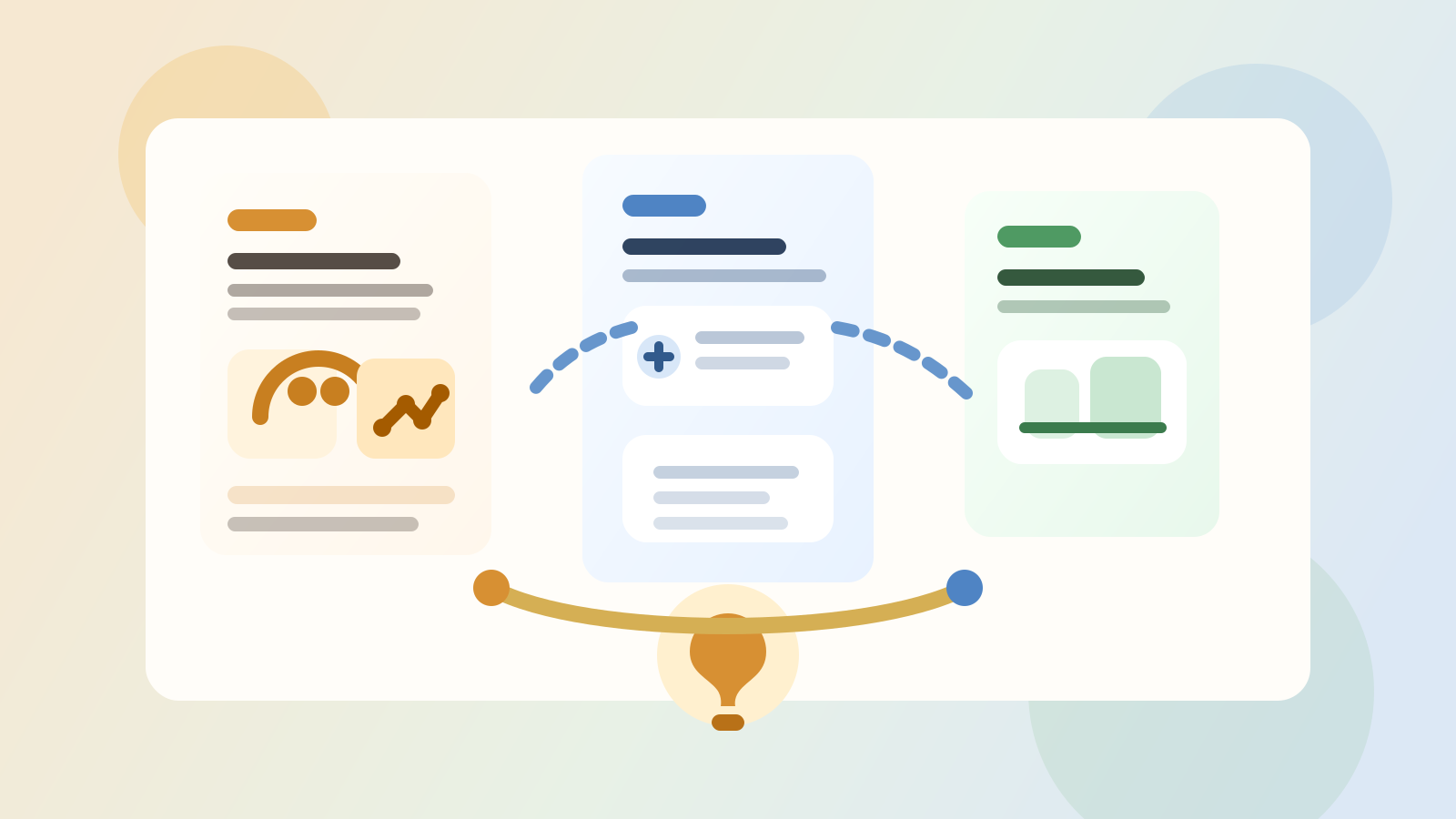
Most arguments about AI at work ask whether to use it. This study asked how. Researchers recruited consultants, data analysts, human-resources professionals, managers, and marketers, then randomly assigned them to complete a role-specific writing task in one of three ways: without AI; by copying ChatGPT's output without changing it; or by writing a first draft themselves and asking ChatGPT to review and edit it. The assignments included press releases, short reports, analysis plans, and delicate emails. Everyone then completed a second, matched writing task without AI.
The 269 people in the primary analysis were the participants who said they followed their assigned workflow, as specified in the preregistration. After the first task, the copy-and-paste group rated their confidence in doing similar work without AI at 5.16 on a seven-point scale, versus 5.63 for the no-AI group. Their sense of ownership averaged 4.35, versus 5.26 for the draft-first group and 5.34 for the no-AI group. They also rated the task as less meaningful: 4.94, compared with 5.46 and 5.54, respectively. 01 / Source noteRelying on AI at work reduces self-efficacy, ownership, and meaning while active collaboration mitigates the effectsScientific Reports · 2026What the source supportsMain result: Draft-first participants did not differ significantly from no-AI participants on confidence, ownership, or meaningfulnessKeep in mindThis was one online experiment built around two ten-minute writing tasks, not a long-term workplace trial. It measured participants' self-reported confidence, ownership, meaning, enjoyment, and satisfaction—not the quality of their writing, productivity, retention, promotion, burnout, or job performance. The follow-up survey broadened the task range but was correlational, so it cannot show that people's usual style of AI use caused their attitudes.Read the original source ↗
The draft-first group did not differ significantly from the no-AI group on confidence, ownership, or meaningfulness. That is the useful finding: keeping the first substantive move for yourself, then using AI as an editor, preserved the three psychological outcomes measured here. Copying AI was initially more satisfying, but that advantage reversed on the next task, when everyone had to work without AI.
What this could change for you
If your job involves writing, the study suggests a simple default: decide what you mean and make a rough first draft before opening the chatbot. Then ask it to challenge, tighten, reorganize, or edit what you made. The experiment did not test every collaborative workflow, but it did test this one against both complete delegation and no AI at all. Drafting first preserved a measurable connection to the work without requiring people to avoid AI.
For managers, the result argues against measuring AI adoption only by how much work employees hand off. A policy that rewards maximum automation may produce fast, satisfying output while weakening the confidence and ownership that help people work independently. Training can instead specify where human judgment must come first: frame the problem, choose the evidence, write the initial position, then use AI for critique and revision.
The effect did not disappear immediately. On the second, AI-free task, people who had previously copied AI output reported lower confidence than the no-AI group, 4.95 versus 5.66, and lower meaningfulness, 5.07 versus 5.54. Psychological ownership, however, rebounded once they did the work themselves. That makes the result a reason to design workflows carefully, not a reason to panic about permanent damage.
From research to everyday use
Can you use this yet?
This brief establishes a result in the study’s setting. A consumer-ready version has not been verified here. Applying the finding elsewhere would require access to the relevant tools or data and testing under those conditions.
Check the study’s limitsWhat it does not prove
This was one online experiment built around two ten-minute writing tasks, not a long-term workplace trial. It measured participants' self-reported confidence, ownership, meaning, enjoyment, and satisfaction—not the quality of their writing, productivity, retention, promotion, burnout, or job performance. The follow-up survey broadened the task range but was correlational, so it cannot show that people's usual style of AI use caused their attitudes.
The experiment also had substantial attrition and noncompliance. Of 562 people who entered, 408 completed the study, and only 269 reported following their assigned workflow. Dropout was higher in the draft-first and no-AI conditions than in the copy-and-paste condition. The authors report similar baseline confidence across included and excluded participants and say full-sample analyses were broadly consistent, but selection remains the biggest weakness.
Finally, “active collaboration” meant one specific sequence: human draft first, AI editing second. Participants used ChatGPT in another browser window, so the researchers could not inspect their prompts or fine-grained behavior. The study does not establish that every human-first workflow works, that starting with an AI outline has the same effect, or that these findings extend beyond short professional writing.
Primary research
Relying on AI at work reduces self-efficacy, ownership, and meaning while active collaboration mitigates the effects
Scientific Reports · 2026 · DOI 10.1038/s41598-026-42312-6