What did AI actually solve?
This is one of the clearest low-risk results in workplace AI so far. A generative-AI assistant did not transform customer support into a fully automated system, but it did help thousands of agents resolve issues faster, especially newer workers who had the most to learn. The honest takeaway is narrower and more useful than the hype: when a job produces lots of comparable cases and reliable feedback, AI can act like a scalable coach.
What changed
Most workplace-AI studies measure a one-off task in a lab. This paper tracked a live deployment. Researchers studied the staggered introduction of a generative-AI conversational assistant used by 5,172 customer-support agents working for a Fortune 500 company that sells business-process software. Most of the agents were based in the Philippines and supported U.S. small-business customers through chat.
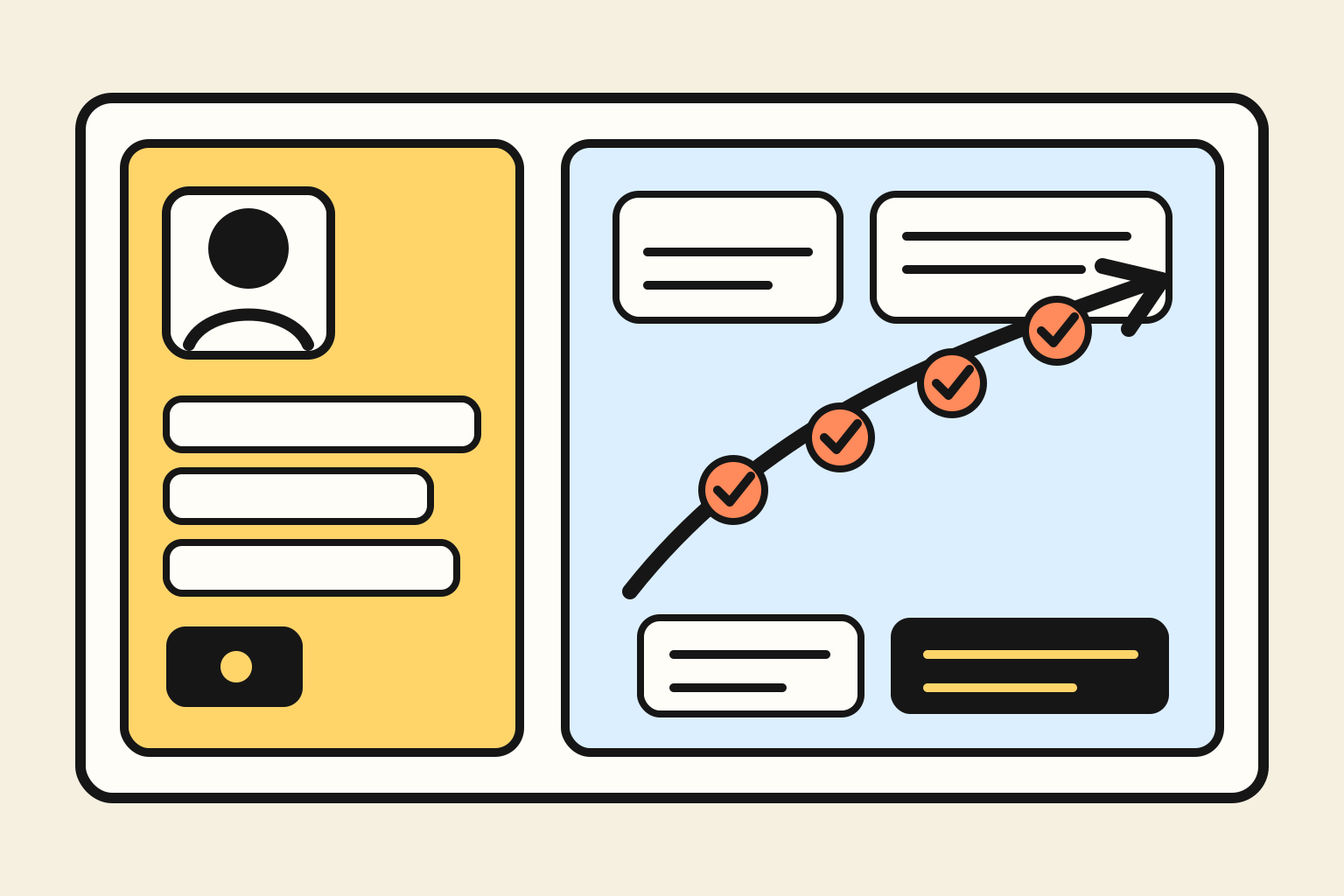
The main outcome was simple and operational: how many customer issues an agent resolved per hour. After the assistant rolled out, productivity increased by 15% on average. The gains were not evenly spread. Less experienced and lower-skilled workers improved both speed and quality, while the most experienced and highest-skilled workers saw only small speed gains and small declines in quality. The pattern fits the paper's core interpretation: the tool helped package the habits of stronger agents in a form newer workers could use immediately. 01 / Source noteGenerative AI at WorkThe Quarterly Journal of Economics · 2025What the source supportsMain result: 15% more issues resolved per hour on average after AI accessKeep in mindThis was one company, one support channel, and one class of task. The agents handled chat-based technical support for a specific software business. The paper does not show that the same tool would work as well in phone support, healthcare navigation, claims handling, consumer retail, or any other service setting with different error costs and different source material.Read the original source ↗
The paper also reports that the assistant seemed to help in places where support work is usually hard to scale. The authors found evidence of faster worker learning, better English fluency among international agents, and the largest gains on moderately rare problems where workers had less baseline experience but the system still had enough prior examples to guide them. Customer interactions also improved on two practical markers: customers were more polite and were less likely to ask to speak to a manager.
What this could change for you
If you manage support, onboarding, or other repeatable service work, the practical lesson is not "replace the team." It is "shorten the ramp." A well-scoped assistant can help newer workers handle real interactions more like experienced colleagues without waiting months for every lesson to come from supervisors alone.
The result also suggests where this kind of AI is most believable. It works best when the job produces many comparable past cases, the right answer can be partly inferred from those cases, and humans can still judge whether the suggestion fits the current problem. Customer support often looks like that. Many jobs that involve one-off strategy, novel edge cases, or high-stakes judgment do not.
For customers, the immediate promise is mundane but real: fewer escalations, less friction, and a better chance that the first agent can solve the problem. That matters more than the abstract idea of AI adoption. The useful benchmark is not whether the system sounds impressive. It is whether it helps a real service interaction end correctly and faster.
From research to everyday use
Can you use this yet?
This brief establishes a result in the study’s setting. A consumer-ready version has not been verified here. Applying the finding elsewhere would require access to the relevant tools or data and testing under those conditions.
Check the study’s limitsWhat it does not prove
This was one company, one support channel, and one class of task. The agents handled chat-based technical support for a specific software business. The paper does not show that the same tool would work as well in phone support, healthcare navigation, claims handling, consumer retail, or any other service setting with different error costs and different source material.
The study also used a staggered rollout, not a pure randomized trial. That still leaves strong evidence because the analysis followed adoption timing across thousands of workers with direct performance measures, but it does not eliminate every organizational confound. The paper's strongest claim is that productivity rose after deployment in this setting, not that every other change in the workplace was impossible.
Finally, the gains were not universal. The best workers benefited least, and the paper itself emphasizes that AI is most useful on problems that are not totally novel and not too common to leave little room for improvement. That is a reminder that the assistant did not "solve customer support" in general. It compressed part of the learning curve inside a narrow workflow with abundant historical examples.
Primary research
Generative AI at Work
The Quarterly Journal of Economics · 2025 · DOI 10.1093/qje/qjae044