What did AI actually solve?
AI did not solve retail forecasting in general. It solved a narrower and more useful problem: matching the level of human involvement to the kind of forecast being made. In this field experiment, human augmentation helped most when demand was stable and the planning window was longer, but full automation worked better when products were newer and timing was tighter.
What changed
Retail demand forecasting is one of those invisible problems that can still shape ordinary life. If a store guesses wrong, you feel it as an empty shelf, a delayed reorder, a substitution, or a pile of overstock that gets discounted later. The usual AI pitch suggests the machine should simply make the call faster than a planner can. This paper tested a more useful question: when should people stay out of the way, and when does human judgment actually help?
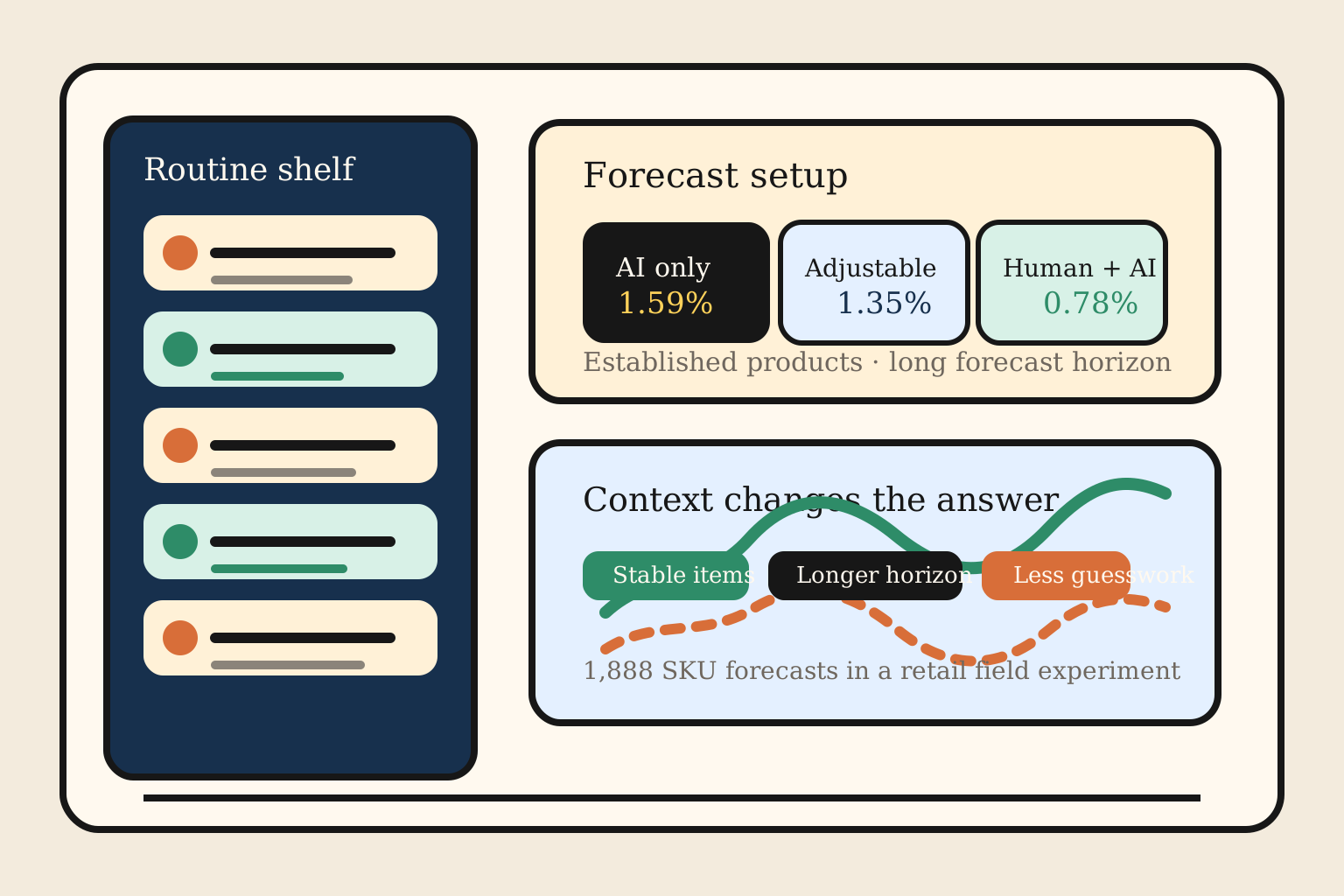
Researchers studied AI/ML-driven demand forecasts for about 1,888 retail SKUs and compared three working modes. In automation, the model forecasted without human intervention. In adjustable automation, humans made a moderate intervention. In augmentation, humans actively complemented the AI forecast. The paper then split the results by two contextual variables that matter in real retail planning: whether a product was innovative or established, and whether the forecast horizon was short or long. 01 / Source noteHuman-Artificial Intelligence Collaboration in Prediction: A Field Experiment in the Retail IndustryJournal of Management Information Systems · 2023What the source supportsMain result: For established long-horizon products, forecast error fell from 1.59% under automation to 0.78% under augmentationKeep in mindThis was one retail setting using about 1,888 SKU forecasts. The study measured forecast accuracy error, not direct customer outcomes such as in-stock rates, fewer stockouts, faster delivery, higher satisfaction, or lower waste visible to shoppers.Read the original source ↗
The main result was not "humans beat AI" or "AI beats humans." It was more specific. For established products over a long forecast horizon, augmentation produced the lowest forecast error at 0.78%, versus 1.35% for adjustable automation and 1.59% for full automation. That is the cleanest positive use case in the paper: a stable product line, more time before demand materializes, and a human planner who can spot context the model may be missing.
The opposite pattern mattered just as much. For innovative products over a short forecast horizon, full automation was best at 0.81%, adjustable automation rose to 1.00%, and augmentation climbed to 1.99%. In other words, the paper is not evidence that more human involvement is always safer. In some faster, less-settled demand environments, human intervention made the forecast worse.
What this could change for you
For shoppers, the believable downstream benefit is not magic inventory perfection. It is a better chance that stores plan routine products more sensibly when the item is stable and planners have time to review the forecast. If a retailer gets those boring high-volume decisions less wrong, that can mean fewer missed purchases, fewer awkward substitutions, and less waste from stocking too much of the wrong thing.
For retail operators, the practical lesson is sharper. Do not turn human review into a default virtue. This study suggests the right operating rule is conditional. Stable products with longer planning windows are the place where human context can improve an AI forecast. Newer products and shorter windows are the place where forcing extra human intervention may add noise instead of wisdom.
The broader AI lesson is about workflow design rather than raw model capability. The strongest use case here is not replacing planners or ignoring them. It is assigning each side the part of the prediction problem it handles best and refusing to assume one human-AI arrangement should govern every decision.
From research to everyday use
Can you use this yet?
This brief establishes a result in the study’s setting. A consumer-ready version has not been verified here. Applying the finding elsewhere would require access to the relevant tools or data and testing under those conditions.
Check the study’s limitsWhat it does not prove
This was one retail setting using about 1,888 SKU forecasts. The study measured forecast accuracy error, not direct customer outcomes such as in-stock rates, fewer stockouts, faster delivery, higher satisfaction, or lower waste visible to shoppers.
The paper operationalized uncertainty through product innovativeness and studied short versus long forecast horizons in that specific environment. It does not prove that the same thresholds, error ranges, or collaboration rules transfer cleanly to every retailer, every category, or every supply chain.
The gains were also context dependent rather than universal. The strongest headline number in the paper applies to established products over longer horizons. That should not be generalized into a claim that human augmentation improves all AI forecasts or that AI solved inventory management as a whole.
Primary research
Human-Artificial Intelligence Collaboration in Prediction: A Field Experiment in the Retail Industry
Journal of Management Information Systems · 2023 · DOI 10.1080/07421222.2023.2267317