What did AI actually solve?
This is a strong low-risk operations result. AI did not reduce energy bills by making firms magically efficient all the time. It helped them avoid a small number of very expensive hours. In a setting where timing matters more than average usage, better forecasts plus concrete response prompts produced real savings. The honest takeaway is that AI looks useful here as a forecasting-and-coordination layer for repeated operational decisions, not as a substitute for energy infrastructure or human judgment.
What changed
This paper tackles a routine but invisible work problem: large organizations can get hit with major electricity penalties if they keep using too much power during a handful of grid-wide demand spikes. The authors studied firms already participating in Ontario's critical peak pricing system, where costs depend heavily on how much electricity a company uses during the five highest provincial demand hours of the year.
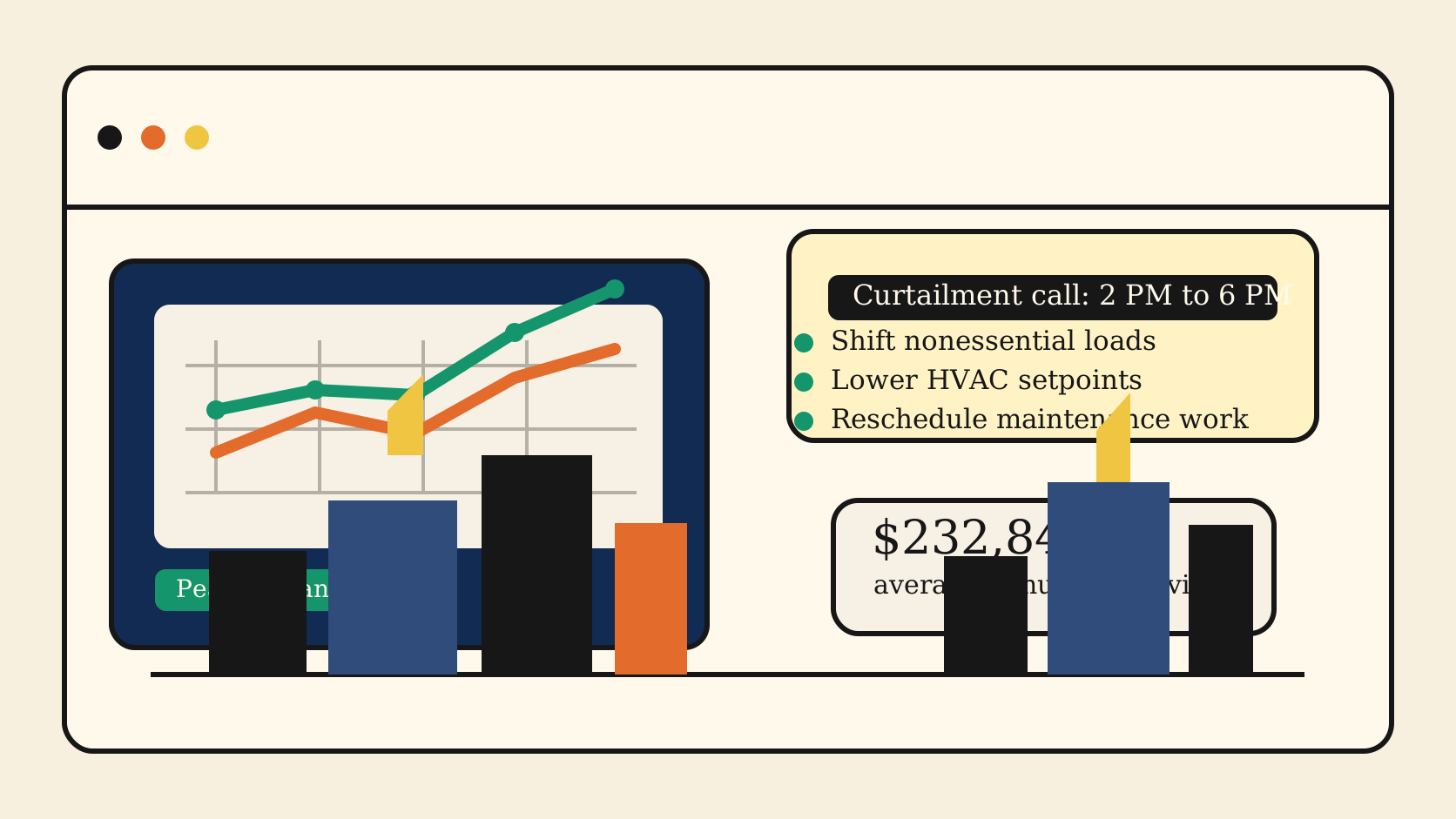
The intervention was not just a better prediction model. It was a full operating system for peak events. First, the partner firm En-Pro used AI-based forecasts to identify likely peak periods. Then the researchers tested whether more concrete curtailment emails could help organizations actually act on those warnings. In the baseline phase, 35 firms cut demand during curtailment windows, and the weighted average reduction was equivalent to 324 kWh per hour. In the field-email phase, organizations that received the experimental email used 265.54 fewer kWh per hour than the control-email group during curtailment hours, a 26.58% decrease. 01 / Source notePractice Paper—AI-Driven Behavioral Nudges for Organizations: An Integrative System for Sustainable Resource ManagementMarketing Science · 2025What the source supportsMain result: 42.13% lower peak-hour demand than a self-managed baseline; $232,843 estimated annual net savings per organizationKeep in mindThis was not a household-energy study, and it was not a consumer app. The participants were large industrial or commercial energy users in Ontario that had already subscribed to an advisory service. That means the result may not generalize to smaller businesses, self-managed organizations with less infrastructure, or residential demand-response programs.Read the original source ↗
The full combined system mattered more than any one phase by itself. The paper's summary table estimates 2,949 kWh of reduced energy demand per organization across the top five annual peaks, $280,215 in gross savings, $47,372 in implementation costs, and $232,843 in net annual savings. Relative to a self-managing baseline, the integrated approach reduced peak-hour energy demand by 42.13%. The authors also estimate broader grid benefits if the approach scaled, but the cleanest practical claim is still the firm-level reduction in peak usage and penalty costs.
What this could change for you
If you run or influence operations in a warehouse, factory, campus, office portfolio, hospital, or other energy-intensive workplace, the practical lesson is straightforward: do not treat peak pricing as a pure forecasting problem. The model helps tell you when to act, but the field experiment suggests clear instructions about how to act still change behavior in a measurable way.
This also points to a believable role for AI in operational work. The system did not autonomously control a building or invent a new energy technology. It helped organizations notice a costly moment early enough to respond, then paired that forecast with concrete prompts such as shifting equipment use, reducing HVAC load, or rescheduling maintenance. That is a narrower claim than saying AI solved energy management, but it is much more defensible.
For workers and managers, the deeper takeaway is about coordination. A lot of expensive waste comes from knowing a problem is coming but failing to turn that warning into timely action across departments. This paper suggests AI can be useful when it supports a repeated operational ritual with real financial stakes, especially when the next action is concrete and time-sensitive.
From research to everyday use
Can you use this yet?
This brief establishes a result in the study’s setting. A consumer-ready version has not been verified here. Applying the finding elsewhere would require access to the relevant tools or data and testing under those conditions.
Check the study’s limitsWhat it does not prove
This was not a household-energy study, and it was not a consumer app. The participants were large industrial or commercial energy users in Ontario that had already subscribed to an advisory service. That means the result may not generalize to smaller businesses, self-managed organizations with less infrastructure, or residential demand-response programs.
The field intervention also bundled multiple email changes together, including planning prompts, simplified messaging, visual salience, and a revised subject line. The paper found no open-rate difference by subject line, but the exact causal contribution of each design element remains unresolved. What is proven is the bundled communication package, not one isolated phrase or formatting trick.
Finally, the result is tied to one regulatory and operational context. The program depends on critical-peak pricing, 24-hour advance notifications, and organizations that can actually shift load without severe business damage. The paper does not show that the same savings would appear in every region, across multiple years, or in sectors where energy use is less flexible.
Primary research
Practice Paper—AI-Driven Behavioral Nudges for Organizations: An Integrative System for Sustainable Resource Management
Marketing Science · 2025 · DOI 10.1287/mksc.2024.1154