What did AI actually solve?
AI did not solve ecommerce. It solved a narrower and more useful problem: helping shoppers get unstuck before they buy. In this seven-experiment retail paper, the strongest results came from fast pre-sale answers and other tools that reduced small but costly shopping frictions. The honest takeaway is that consumer AI looks strongest here when it removes confusion and waiting, not when it tries to replace human judgment altogether.
What changed
Online shopping sounds effortless until you hit the moment where the product page still leaves a basic question unanswered. Does this charger fit my device? Is the sizing chart trustworthy? Can I describe what I want well enough for the search engine to find it? That small pause is where a lot of buying friction lives.
This paper looked at that friction across the whole shopping journey instead of testing one flashy chatbot demo. Researchers partnered with a large cross-border ecommerce platform and ran seven randomized field experiments between September 2023 and June 2024. The workflows covered pre-sale customer support, search query refinement, product descriptions, marketing messages, Google ad titles, chargeback defense, and live chat translation. Within each workflow, the only planned difference between treatment and control was the addition of GenAI to the existing system. 01 / Source noteGenerative AI and Sales Productivity: Field Experiments in Online RetailarXiv preprint · 2026What the source supportsMain result: Pre-sale GenAI replies versus no service raised sales 16.25% and conversion 21.70%; positive deployments together implied about $4.6 to $5.2 annual value per consumerKeep in mindThis was one cross-border ecommerce platform operating in a particular organizational setup. The paper does not prove that the same gains will transfer unchanged to Amazon-style marketplaces, specialty retailers, grocery apps, luxury products, or markets with different customer-service expectations.Read the original source ↗
The strongest result came from the pre-sale service chatbot. In the main comparison, consumers who could use a GenAI reply tool instead of getting no live pre-sale service spent 16.25% more and converted 21.70% more often, based on 44,614 consumer observations. Against human-only replies, GenAI alone did not significantly outperform human service. But a hybrid setup that used GenAI with human escalation lifted sales 11.53% relative to human-only service and 25.03% relative to no service.
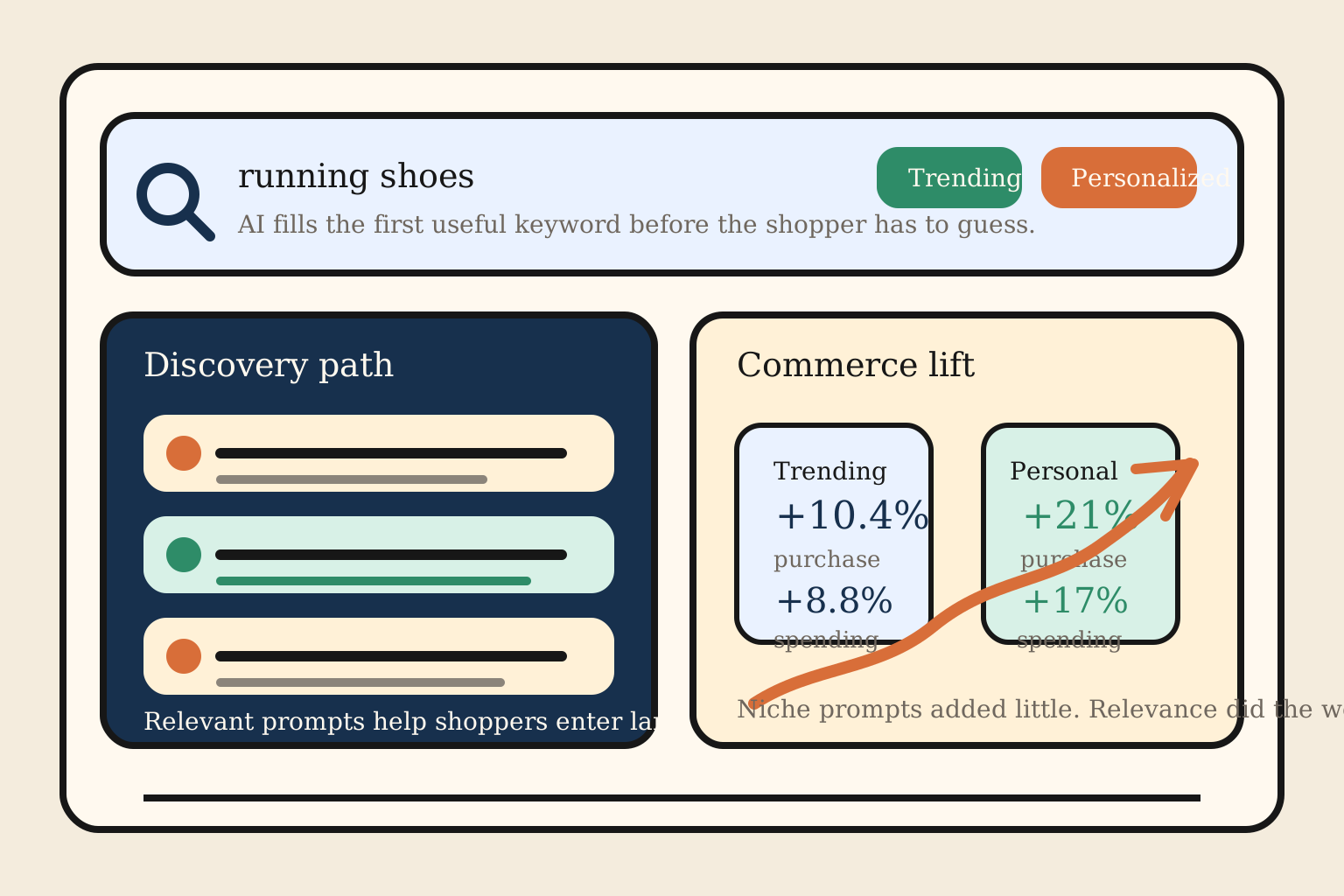
The broader pattern matters because it kept the paper honest. Search-query refinement and AI-written product descriptions produced smaller gains, typically around 2% to 3%. The advertising-title experiments showed no detectable sales lift. Across the four deployments with positive sales effects, the authors estimate roughly $4.6 to $5.2 in annual incremental value per consumer. The paper also reports no deterioration in the post-purchase outcomes it measured: return rates and customer ratings did not worsen overall, and some workflows showed lower return rates or slightly better ratings.
What this could change for you
For shoppers, the believable benefit is not an autonomous shopping agent that replaces your judgment. It is faster help at the exact points where online buying gets annoying: asking a pre-sale question, phrasing a search query, or figuring out a product page that is vague or poorly localized. If AI works here, it works by removing delay and confusion before checkout.
For retail platforms, the practical lesson is narrower than "deploy GenAI everywhere." The biggest gains appeared where the baseline experience was weakest, especially when there was no interactive pre-sale service to begin with. That suggests the best use case is not showing off a model. It is fixing a specific service gap that already costs real purchases.
The heterogeneity result also matters. Less experienced consumers benefited more across the positive workflows. In plain English, AI looked most useful for buyers who have less product knowledge, weaker search instincts, or fewer shortcuts for deciding what to trust.
From research to everyday use
Can you use this yet?
This brief establishes a result in the study’s setting. A consumer-ready version has not been verified here. Applying the finding elsewhere would require access to the relevant tools or data and testing under those conditions.
Check the study’s limitsWhat it does not prove
This was one cross-border ecommerce platform operating in a particular organizational setup. The paper does not prove that the same gains will transfer unchanged to Amazon-style marketplaces, specialty retailers, grocery apps, luxury products, or markets with different customer-service expectations.
The paper is an arXiv preprint, not yet a peer-reviewed journal article. The randomized design is strong, but the evidence still deserves the extra scrutiny that comes with formal review, revision, and outside replication.
The headline 16.25% sales gain comes from comparing GenAI replies with no live pre-sale service, not with a human support agent. Against human-only replies, GenAI alone was statistically indistinguishable in the reported sales and conversion comparisons. The paper also studies short-run business outcomes and measured post-purchase proxies, not long-term loyalty or whether the mechanism was truly better information rather than some mix of information, persuasion, and convenience.
Primary research
Generative AI and Sales Productivity: Field Experiments in Online Retail
arXiv preprint · 2026 · DOI 10.48550/arXiv.2510.12049