What did AI actually solve?
AI did not solve creativity at work in general. It solved a narrower and more believable problem: helping some employees break creative block when they know how to use the tool actively. In this field experiment, ChatGPT improved supervisor-rated creativity and external novelty, but the gains depended on workers bringing their own self-monitoring and adjustment skills to the collaboration.
What changed
This paper asks a practical workplace question that a lot of generative-AI stories blur past: does access to ChatGPT actually help people come up with better ideas on the job, or does it mostly add another tool to the pile? The researchers worked with a technology consulting firm in China in August 2023, when the company had already built an internal interface to OpenAI's API. That let them run a real workplace experiment instead of a lab task.
The company had 286 eligible nonmanagerial employees across technology, sales and consulting, and administration. After 36 missed the study because of travel or illness, the final sample was 250. On August 7, the researchers randomly assigned participants to a treatment group that received ChatGPT accounts or a control group that did not. One week later, they measured creativity in two ways: direct supervisors rated employees' general creative performance over the week, and two external raters scored written responses about protecting employee privacy in digital workplaces for novelty and usefulness. 01 / Source noteHow and for whom using generative AI affects creativity: A field experimentJournal of Applied Psychology · 2025What the source supportsMain result: Supervisor-rated creativity rose 0.84 points and external novelty rose 0.25 points; usefulness was not significant in the main controlled modelKeep in mindThis was one company in China over roughly one workweek. The result came from a technology consulting firm that already had an internal OpenAI API interface and a workplace where creativity is a valued part of the job. The paper does not establish that the same effect would appear in manufacturing, retail operations, call centers, public agencies, or firms with different norms, languages, or tool access.Read the original source ↗
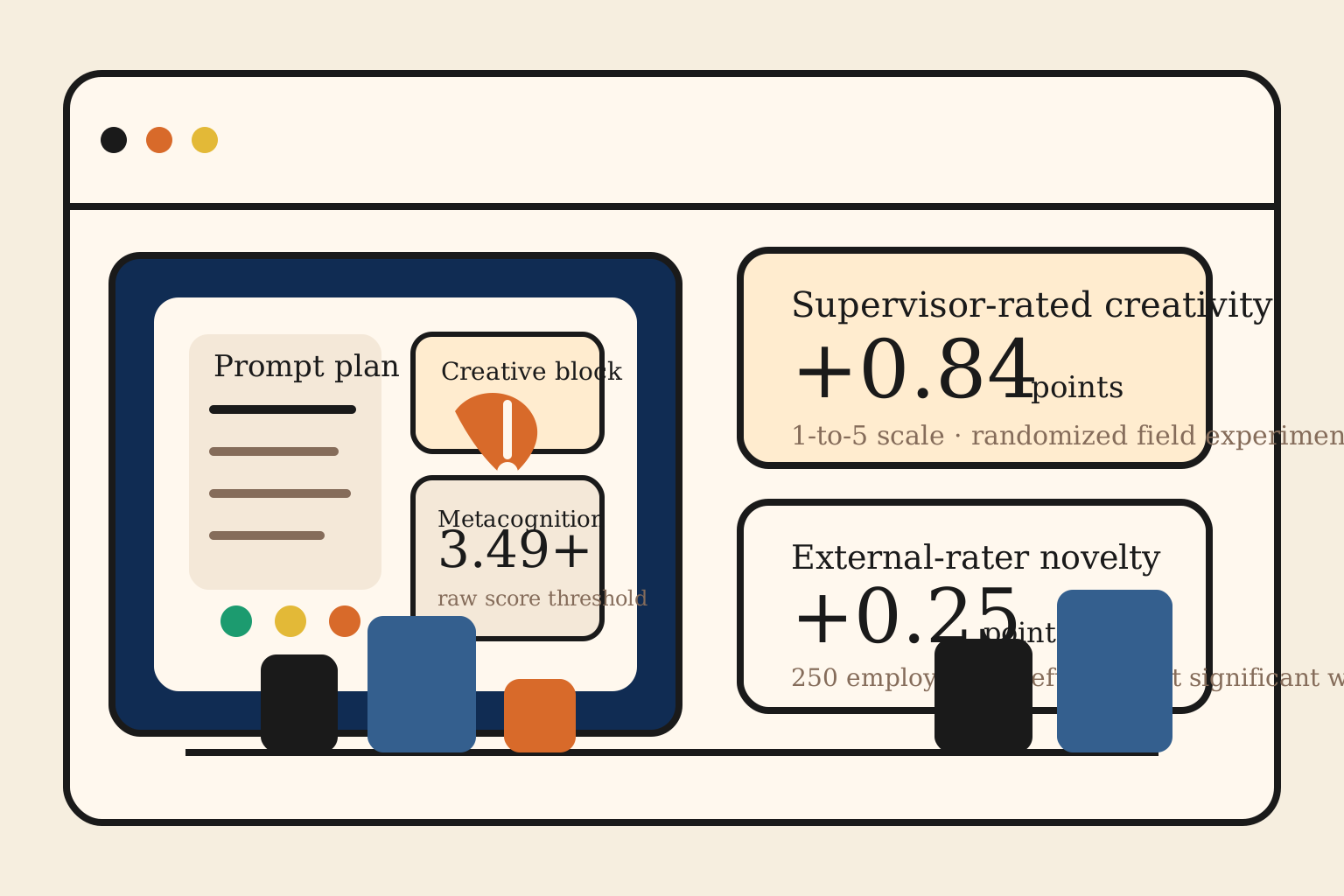
The top-line result was positive but narrower than "AI makes workers more creative." ChatGPT access increased supervisor-rated creativity by 0.84 points on a 1-to-5 scale and increased external-rater novelty by 0.25 points. The usefulness rating did not rise significantly once the main controls were included. The paper's more important result is the boundary condition. Employees benefited when they already used stronger metacognitive strategies: actively analyzing tasks, monitoring whether their approach was working, and revising it when needed. The Johnson-Neyman analysis found the creativity mechanism became significant when the raw metacognitive-strategy score reached 3.49 or higher on the 1-to-5 scale.
What this could change for you
If you manage analysts, consultants, designers, marketers, or other knowledge workers, the practical lesson is not "buy ChatGPT and expect more originality." The credible use case is more operational. A language model can help people gather information, switch between harder and easier parts of a task, and get unstuck faster, but only when they are already steering the work instead of passively accepting output.
That matters for AI rollout decisions. This study suggests the limiting factor may not be the model alone. It may be whether workers know how to spot a knowledge gap, test a line of reasoning, and rewrite a prompt or plan when the first answer is weak. In other words, some of the gains from workplace AI may come less from raw model power and more from the combination of a capable model with better self-monitoring habits.
For individual workers, the useful takeaway is modest and actionable. If you use ChatGPT for ideation, planning, or reframing a problem, the tool may work best when you treat it like a thinking aid rather than a substitute thinker. The paper does not show a universal creativity boost, but it does show that guided, reflective use can improve creative performance in a real job setting over a normal workweek.
From research to everyday use
Can you use this yet?
This brief establishes a result in the study’s setting. A consumer-ready version has not been verified here. Applying the finding elsewhere would require access to the relevant tools or data and testing under those conditions.
Check the study’s limitsWhat it does not prove
This was one company in China over roughly one workweek. The result came from a technology consulting firm that already had an internal OpenAI API interface and a workplace where creativity is a valued part of the job. The paper does not establish that the same effect would appear in manufacturing, retail operations, call centers, public agencies, or firms with different norms, languages, or tool access.
The outcome measures also matter. Supervisor-rated creativity and external novelty improved, but external usefulness was not significant in the main controlled model. That means the cleanest claim is that LLM access helped workers produce ideas judged as more creative or novel, not that it reliably made their suggestions more practical in every evaluation frame.
The mechanism measure has its own limitation. Metacognitive strategies were self-reported, and the authors explicitly flag that as a constraint even though the treatment was randomized and the creativity outcomes came from supervisors and external raters. The paper also does not answer the long-term question. Extended LLM use could compound benefits for reflective workers, but it could also create dependence that weakens independent thinking over time.
Primary research
How and for whom using generative AI affects creativity: A field experiment
Journal of Applied Psychology · 2025 · DOI 10.1037/apl0001296