What did AI actually solve?
AI did not solve selling in general. It solved a narrower and more believable problem: helping human online sales agents reply in ways that convert better. In this randomized field experiment, the gain was real, the biggest benefits landed with less-experienced workers, and the honest takeaway is that AI looked strongest as a human-sales assist layer, not as a replacement for the person in the conversation.
What changed
Most shopping AI stories focus on the customer-facing bot. This paper tested a narrower question that matters just as much: what happens when the buyer still interacts with a human, but that human gets AI help while selling?
The researchers ran a two-by-two factorial randomized field experiment in an e-commerce setting and compared sales outcomes handled by human agents alone with outcomes handled by agents augmented by AI. The publisher metadata and structured abstract report 1,090 experimental observations and say the main outcome moved in a practical direction: AI augmentation increased sales by 5.46%. 01 / Source noteHow effective is AI augmentation in human-AI collaboration? Evidence from a field experimentInformation Technology & People · 2024What the source supportsMain result: AI augmentation increased sales 5.46%; inexperienced agents benefited nearly six times moreKeep in mindThis was one e-commerce sales context. The abstract does not establish that the same 5.46% lift would transfer unchanged to luxury retail, enterprise software, phone sales, financial products, or any higher-stakes purchase where trust, regulation, or product complexity change the interaction.Read the original source ↗
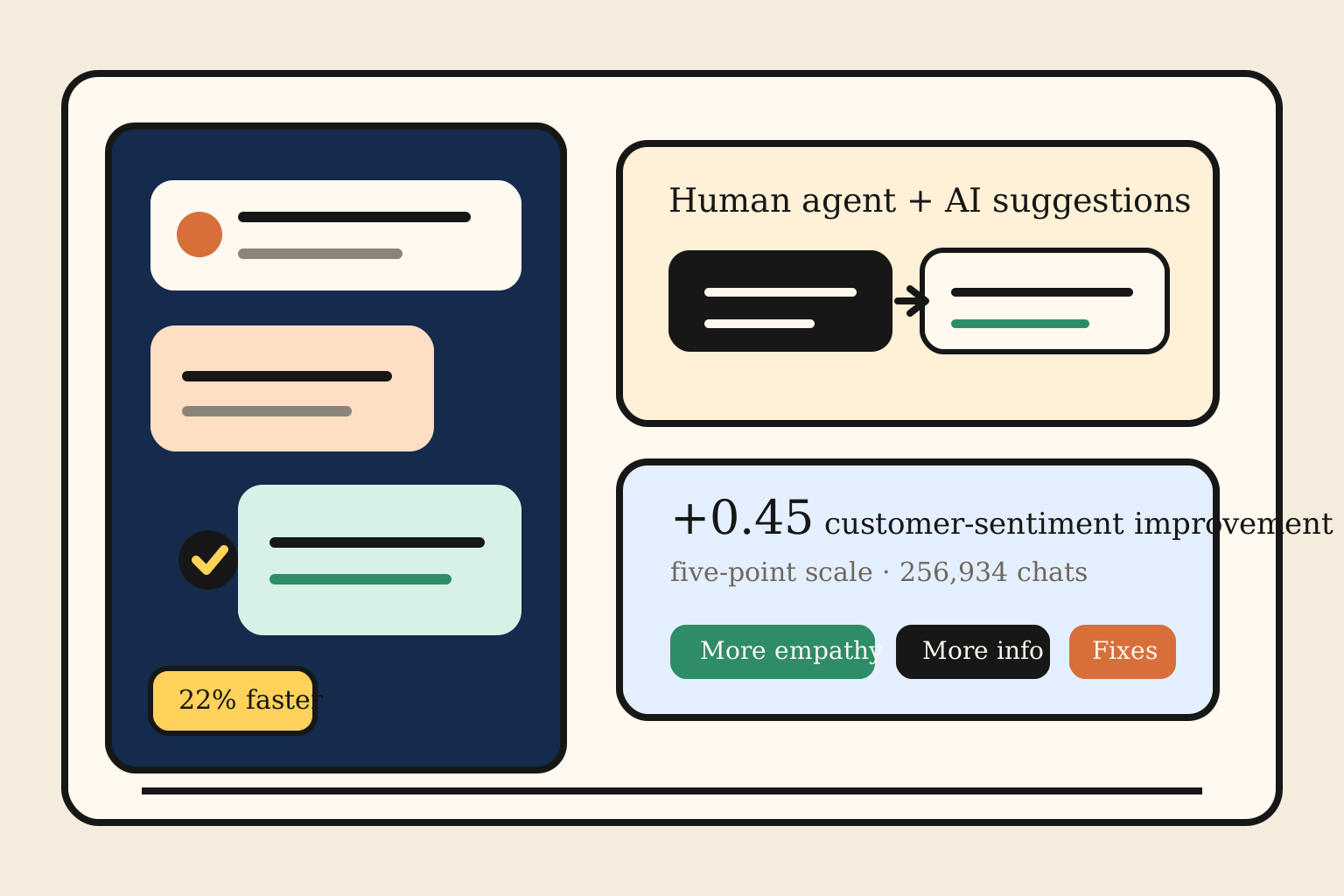
The paper's more useful claim is not simply that "AI sells more." It is that the gain seems to come from how agents respond. The mediation analysis reported in the abstract links the sales lift to faster replies, more accurate replies, and more positive sentiment in the agents' messages. In other words, the AI looked useful here as a response-quality scaffold rather than as a fully autonomous salesperson.
The strongest heterogeneity result is also the most believable one. Inexperienced agents benefited nearly six times as much as experienced agents. That makes this look less like a universal replacement story and more like a coaching or gap-closing tool that helps weaker or newer sellers perform more like stronger ones.
What this could change for you
For shoppers, this is a plausible way AI could improve online buying without forcing you into a bot-only experience. The human stays in the loop. What changes is that the person answering your question may reply faster, with better wording and better product guidance before you decide whether to buy.
For sales teams, the practical use case is narrower than "turn AI loose on customers." The result points toward in-the-loop assistance for agents who need help with speed, consistency, and tone. If the biggest gains land with less-experienced workers, the best first deployment is likely training and augmentation rather than replacement.
The paper also fits a broader pattern already visible across other low-risk AI work studies: some of the most credible gains come when AI improves a small friction point inside an existing workflow. Here, that friction point is the quality and speed of human sales replies.
From research to everyday use
Can you use this yet?
This brief establishes a result in the study’s setting. A consumer-ready version has not been verified here. Applying the finding elsewhere would require access to the relevant tools or data and testing under those conditions.
Check the study’s limitsWhat it does not prove
This was one e-commerce sales context. The abstract does not establish that the same 5.46% lift would transfer unchanged to luxury retail, enterprise software, phone sales, financial products, or any higher-stakes purchase where trust, regulation, or product complexity change the interaction.
The publisher and Crossref abstract records support the reported randomized design, sample size, sales effect, experience split, and proposed mechanisms. They do not, by themselves, expose the full operational details a complete paper review would provide about workflow design, product category, or long-term customer outcomes. That is one reason this story stays tightly bounded to the published abstract claims.
The main business outcome is sales lift, not proof of better long-term customer welfare. A faster or more persuasive sales reply could still be a mixed result if it pushed the wrong product, increased returns later, or worked only in narrowly structured conversations. The abstract does not claim those broader outcomes were solved.
Primary research
How effective is AI augmentation in human-AI collaboration? Evidence from a field experiment
Information Technology & People · 2024 · DOI 10.1108/ITP-11-2022-0859