What did AI actually solve?
AI did not solve urban transportation. It solved a smaller but real part of taxi work: finding the next passenger faster. In Yokohama, a machine-learning route tool cut search time by about 5% overall and helped lower-skilled drivers the most. The honest takeaway is that AI looks strongest here as a prediction layer for a repetitive search task, not as a replacement for drivers or a promise of transformed city traffic.
What changed
This paper studies a routine work problem that is easy to recognize even if you have never driven a cab: a driver can only earn money after finding the next passenger, and a large share of the shift is spent searching. The AI system in the study, called AI Navi, did not drive the car or set prices. It suggested cruising routes where passenger demand was predicted to be higher, given the taxi's current location.
The setting was Yokohama, Japan, in December 2019. A tech company gave 520 taxi drivers free access to the tool for 29 days and let them decide whether to use it. The researchers then focused on the 198 drivers who turned it on at least once and analyzed 25,039 street-hailing search trips, comparing the same drivers when the AI was on and off while controlling for driver, place, and time conditions. They also used an instrumental-variable check based on how familiar drivers were with the previous drop-off area. 01 / Source noteAI, Skill, and Productivity: The Case of Taxi DriversManagement Science · 2025What the source supportsMain result: Search time fell about 5% overall and 7% for lower-skilled drivers; the productivity gap narrowed 13.4%Keep in mindThis was one city, one month, one taxi market, and one specific tool. The result came from conventional taxi drivers in Yokohama during a free trial, not from ride-hailing drivers, delivery fleets, or cities with different street patterns, pricing systems, or labor arrangements. The paper itself calls this a case study.Read the original source ↗
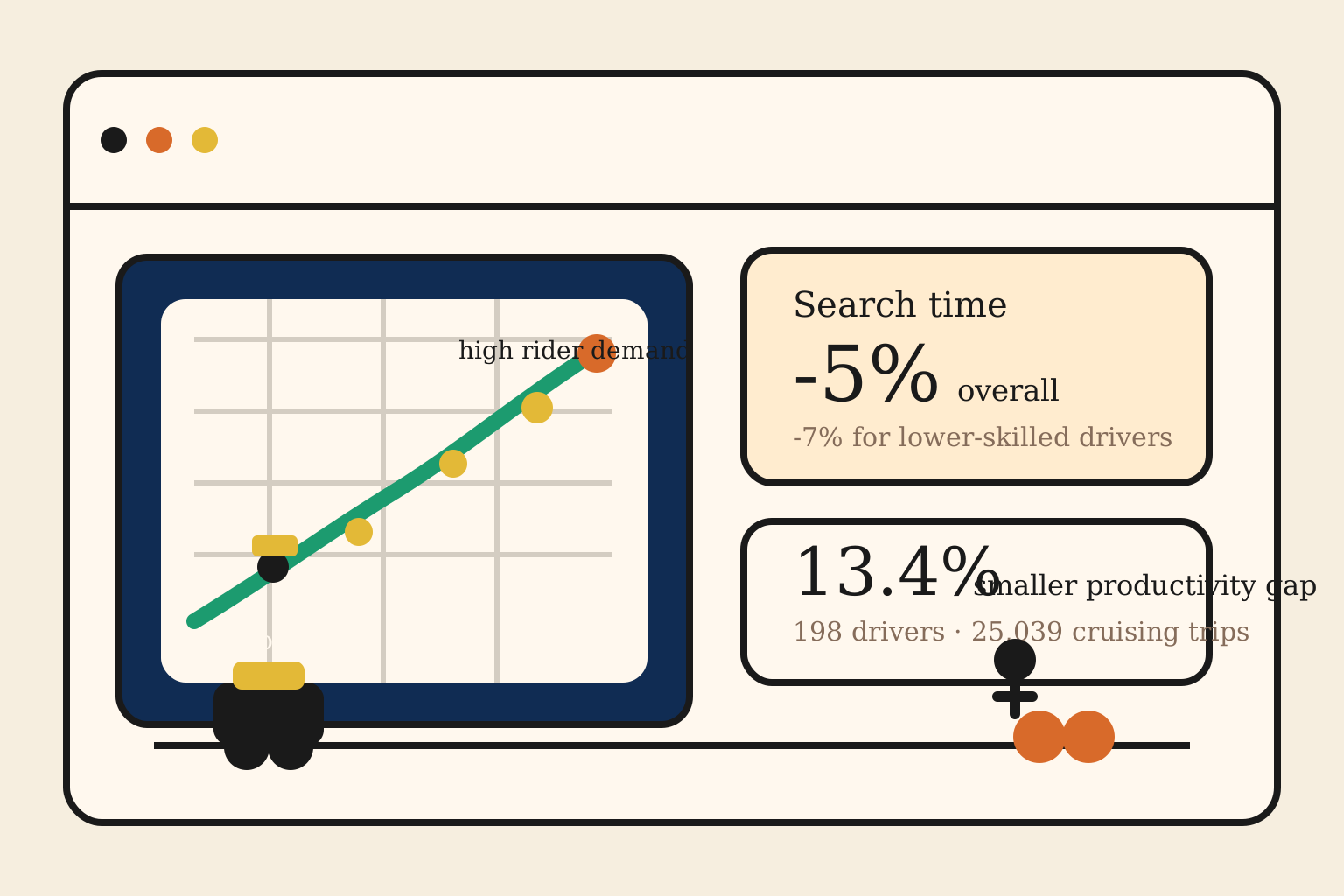
The main result was practical rather than flashy. Turning on the AI shortened search time by about 5% on average. The gain was concentrated among lower-skilled drivers, whose search time fell by about 7%, while the estimated effect for higher-skilled drivers was near zero. Because of that asymmetry, the productivity gap between high- and low-skilled drivers narrowed by 13.4%. The paper also reports why this is narrower than "AI made taxis better": the tool was helping with one prediction-heavy task, finding the next likely passenger, not with the rest of the job.
What this could change for you
If you drive for a taxi fleet, run local transport operations, or manage workers whose day includes a repeated search problem, this is a believable AI use case. The system did not replace judgment about safety, customer service, or the economics of a whole shift. It handled a constrained prediction problem that humans learn unevenly: where demand is likely to be strongest right now.
For less experienced or less locally skilled workers, that matters more than a headline productivity number. The practical implication is that some AI systems may work best as fast equalizers. Instead of making the top performers dramatically better, they can help weaker performers waste less time on the part of the job that depends most on pattern recognition from messy local data.
For riders, the benefit is indirect but still understandable. If drivers find the next passenger faster, idle cruising falls and the time between available rides can shrink. This paper does not prove citywide wait-time improvements or cheaper fares, but it does show one place where predictive AI can reduce friction in everyday urban transportation without asking the public to trust a fully autonomous vehicle.
From research to everyday use
Can you use this yet?
This brief establishes a result in the study’s setting. A consumer-ready version has not been verified here. Applying the finding elsewhere would require access to the relevant tools or data and testing under those conditions.
Check the study’s limitsWhat it does not prove
This was one city, one month, one taxi market, and one specific tool. The result came from conventional taxi drivers in Yokohama during a free trial, not from ride-hailing drivers, delivery fleets, or cities with different street patterns, pricing systems, or labor arrangements. The paper itself calls this a case study.
The outcome was narrower than earnings or service quality. The AI was designed to maximize the probability of finding a customer, not the value of the next fare. The paper does not establish higher driver income, higher fare per ride, lower passenger prices, better service, or citywide reductions in congestion.
Adoption was also limited. Only 198 of the 520 trial drivers ever used the system, and just 12.6% of analyzed cruising trips had the AI turned on. That means the result is evidence that the tool can help in real work, not evidence that drivers will naturally keep using it, or that the same gain survives when most of the local market adopts the same suggestions.
Primary research
AI, Skill, and Productivity: The Case of Taxi Drivers
Management Science · 2025 · DOI 10.1287/mnsc.2023.01631